

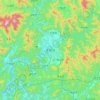
Daegu topographic map
Click on the map to display elevation.
About this map

Name: Daegu topographic map, elevation, terrain.
Location: Daegu, 41939, South Korea (35.71130 128.44180 36.03130 128.76180)
Average elevation: 699 ft
Minimum elevation: 16 ft
Maximum elevation: 3,858 ft
Other topographic maps
Click on a map to view its topography, its elevation and its terrain.

Jeju Island
The climate of the highlands in the middle of the island where Hallasan is located is quite different from that of the rest of the island. As the altitude increases, the average temperature decreases and the climate becomes colder. The highlands of Jeju Island have the highest annual precipitation in Korea.
Average elevation: 322 ft





Daejeon
In 1973, Buk-myeon and Yuseong-myeon of Daedeok-gun were each elevated to Sintanjin-eup and Yuseong-eup, respectively. In 1977, the ward system (gu-je) was implemented in Daejeon, establishing two wards: Jung-gu and Dong-gu. In 1983, Daejeon further expanded by incorporating the entire areas of Yuseong-eup and…
Average elevation: 522 ft


Yongsan-gu
Yongsan is located next to the Han River, with level ground in the west of the district which has been used for transportation (rail) and commercial use since the early 20th century. To the east and north in the land is steeper and rises towards Namsan which lies to the north. Namsan has an elevation of 243m…
Average elevation: 128 ft
Jeju
The island is home to 660,000 people, but hosts 15,000,000 visitors per year. English is not widely spoken in Jeju, and as a matter of fact, "the local dialect is different enough from Korean that it is recognized as a distinct language." "Until recently, Chinese travelers accounted for 80% of foreign…
Average elevation: 92 ft








Jeju Island
The climate of the highlands in the middle of the island where Hallasan is located is quite different from those of the rest of the island. The higher the altitude, the lower the average temperature and the colder the climate. The highlands of Jeju Island have the highest annual precipitation in Korea.
Average elevation: 322 ft




Pyeongtaek-si
With its low average elevation, Pyeongtaek has the warmest January average temperature in Gyeonggi Province at -4.5°C and the hottest average temperature in August at 26.4°C. The annual average precipitation is 1,100 millimeters with an average of 283.4 millimeters in July and 207.3 millimeters in August,…
Average elevation: 197 ft



Seoraksan National Park
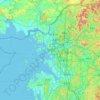
The reserve has an area of 163.6 square kilometres (63.2 sq mi) and includes many mountain peaks measuring over 1,200 metres above sea level, the tallest being Daecheongbong, at an altitude of 1,708 metres (5,604 ft). The ranges are composed largely of dissected granite and gneiss. The annual precipitation is…
Average elevation: 2,005 ft

Extent of Japanese claim at Dokdo
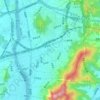
The Liancourt Rocks, known in Korea as Dokdo (Korean: 독도) and in Japan as Takeshima (Japanese: 竹島), are a group of islets in the Sea of Japan between the Korean Peninsula and the Japanese archipelago administered by South Korea. The Liancourt Rocks comprise two main islets and 35 smaller rocks; the…
Average elevation: 0 ft

Daejeon
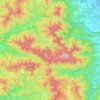
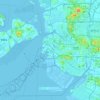
In 1973, Buk-myeon and Yuseong-myeon of Daedeok-gun were each elevated to Sintanjin-eup and Yuseong-eup, respectively. In 1977, the ward system (gu-je) was implemented in Daejeon, establishing two wards: Jung-gu and Dong-gu. In 1983, Daejeon further expanded by incorporating the entire areas of Yuseong-eup and…
Average elevation: 522 ft


Sangju-si
All of Sangju lies in the valley of the Nakdong River. Various tributaries flow into the Nakdong in Sangju, including the Yeong (which rises in Mungyeong). The land slopes down from the Sobaek Mountains in the east to the river basin. The highest elevation in Sangju is found at the top of Songnisan, 1,058 m…
Average elevation: 709 ft

Taebaek-si
Taebaek (Korean: 태백; Korean pronunciation: [tʰɛ̝.bɛ̝k̚]) is a city in the state of Gangwon, South Korea. Its name is shared with that of the Taebaek Mountains. Situated at an elevation of 650 to 700 m (2,130 to 2,300 ft), Taebaek is the second highest city in South Korea, after Pyeongchang.
Average elevation: 2,602 ft


Jeju
The island is home to 660,000 people, but hosts 15,000,000 visitors per year. English is not widely spoken in Jeju, and as a matter of fact, "the local dialect is different enough from Korean that it is recognized as a distinct language." "Until recently, Chinese travelers accounted for 80% of foreign…
Average elevation: 92 ft


Ulleungdo Island
South Korea > Ulleung-gun > Namyang-ri
Ulleungdo (also spelled Ulreungdo; Hangul: 울릉도, IPA: [uɭːɯŋdo]) is a South Korean island 120 kilometres (65 nmi; 75 mi) east of the Korean Peninsula in the Sea of Japan, formerly known as Dagelet Island or Argonaut Island in Europe and sometimes referred to as Matsushima on 19th-century maps.…
Average elevation: 620 ft
Seodaemun-gu
Seodaemun District incorporates residential areas and historical areas including Bongwon Temple, Sinchon Railway Station (the oldest train station in Seoul) and Seodaemun Prison History Hall. Also it has a historic culture site "Seodaemun Independence Park." This place located at Dongnimmun station, includes a…
Average elevation: 230 ft
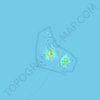
Dokdo Island
South Korea > Ulleung-gun > Dokdo-ri
The Liancourt Rocks, also known by their Korean name of Dokdo or their Japanese name of Takeshima, are a group of islets in the Sea of Japan between the Korean peninsula and the Japanese archipelago administered by South Korea. The Liancourt Rocks comprise two main islets and 35 smaller rocks; the total…
Average elevation: 0 ft

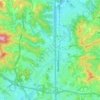
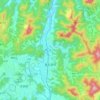
Jeju Island
The climate of the highlands in the middle of the island where Hallasan is located is quite different from that of the rest of the island. As the altitude increases, the average temperature decreases and the climate becomes colder. The highlands of Jeju Island have the highest annual precipitation in Korea.
Average elevation: 322 ft
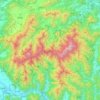


Seoraksan National Park
The reserve has an area of 163.6 square kilometres (63.2 sq mi) and includes many mountain peaks measuring over 1,200 metres above sea level, the tallest being Daecheongbong, at an altitude of 1,708 metres (5,604 ft). The ranges are composed largely of dissected granite and gneiss. The annual precipitation is…
Average elevation: 2,005 ft